CHANS Lab Views by Kai Chan's lab is licensed under a Creative Commons Attribution-ShareAlike 4.0 International License.
Based on a work at https://chanslabviews.blogspot.com.

By Kai Chan for CHANS Lab Views
This is (an extra) part of a series, How to Write a Winning Proposal—in 10 Hard Steps (why Author Contributions at the proposal stage? Because you need to think about these issues early: read on!)
Who did what? Who deserves the real credit, and who came along for the ride? Who contributed what %?
Author Contributions statements for papers, theses, and tenure files are far more important than they might seem. Writing these little statements well is also far more difficult than it appears. I learned this the hard way, with an epic fail at one of the most important junctures of my professional career.
This difficulty isn’t helped by understandable but mistaken notions that these statements are about the ‘real credit’ or percent contributions.
I was going up for promotion—a crucial moment in an academic’s career. My director, who had to write the crucial departmental letter that would accompany my file to the higher levels at the university, was also a coauthor on one of the articles I submitted. I was directed to write a statement clarifying my contributions to the papers. I interpreted it as “Show that this was mostly your work—that you brought the key ingredients, not your coauthors”. Error #1.
My director/coauthor flagged a concern. Ouch. I reread the statement to understand. It started with my contributions, and followed with my coauthor’s, almost as if these were an afterthought barely worth mentioning. I also averaged-up—that is, if I felt I did most of a task (e.g., designing the analysis), I assigned it to myself. E.g., “I designed and executed the analysis, I wrote the paper. My coauthor edited.” Now imagining my coauthor’s perspective, my heart surged, my face flushed, and shame and disgust washed over me. What I wrote wasn't false, but it was certainly not an equal representation of both sets of contributions. It oriented around mine, because that's how I understood the task (wrongly).
The irony was palpable. I had already become excited about relational values (preferences, principles and virtues associated with human relationships involving nature; see also here), and I had been consciously thinking relationally in general. That is, I had been thinking first about how actions reflected and built appropriate relationships, and only second how they yielded positive or negative consequences. Here, I clearly failed: I had unconsciously treated the authorship statement as a means to the end of impressing reviewers, entirely missing their crucial contributions to building or eroding the relationships I sought with cherished colleagues.
Ugh.
One might think, following such a teachable moment of shame, that I would have written flawless Author Contributions statements ever since. I wish I could say that were true. I don’t normally make the same mistake twice, but Author Contribution statements are full of ways to fail.
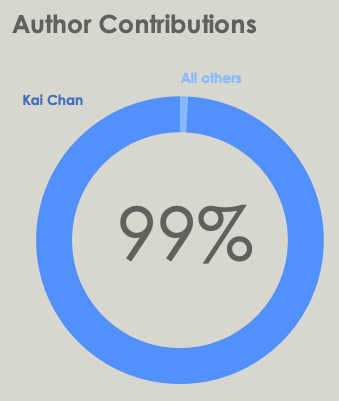
| If we think of the hours spent directly on the manuscript, we may think like this. But that doesn't tell the full story. |
More recently, the same cherished coauthor and I were wrapping up a paper many years in the making (almost a decade). Finally, it was time to write an author contributions statement. I was conscious to err on the side of generosity. I listed our contributions together (not mine first). I emphasized shared contributions to tasks wherever it seemed appropriate. But by my recollection, I had approached my coauthor with the idea, and indeed, with a draft of what I felt we needed to say, and she had responded to that. So, I wrote something like, “KC wrote the first draft.”
It was déjà vu when my coauthor responded with edits and comments, with her recollection that we co-wrote the first draft. My coauthor pointed out that it had been her idea to include an empirical component at all. I had started counting ‘first draft’ from even before there had been an empirical component (which was now the central identity of the paper). The paper sure was different back then, without its central contribution. Point taken, absolutely we co-wrote the first real draft of the current paper.
Worse, though, my mind full of the many hundreds of hours that I spent coding papers and refining the analysis without troubling my coauthor, I claimed credit for designing the analysis. She contested that, politely and respectfully, as always. When I wrote the statement, I didn’t even remember that it had been my coauthor’s idea to do an analysis, and indeed that we had discussed some of the major codes right at the outset. It wasn’t a long, involved or contentious conversation, so it didn’t even spring to mind. But it clearly structured everything that followed.
Double ugh.
This time, I had been thinking consciously with the lessons from last time. I had thought I was being generous. But my thinking was skewed by my memory, which was rooted in hours spent and emotion-laden moments as indicators of contributions. Key structural conversations from many years ago were overlooked.
It’s so much easier to remember one’s own contributions than others. I think in our own minds, others’ contributions often become momentary guidance in a journey that we travelled mostly solo.
Subconsciously, I was thinking about percent contributions as hours spent on the paper. In contrast, I had consciously brought my coauthor on board because I knew that she would leverage countless hours of her reading and thinking of different but complementary literatures into a focused contribution on the manuscript. And I knew that this focused contribution might enable the paper to be rich and beautiful.
I’ve also had experiences on the other side, of course, because I think it’s hardest for students to see their supervisor’s contributions because they structure what follows. One wonderful student had joined me to do a project that I had envisioned well before the student’s degree. He had first written about my contributions as the same as other coauthors (e.g., editing drafts). These other coauthors were ones I had suggested as committee members, while helping this student envision what the project could look like and how it could make a great contribution to the literature and to problems that we both seemed to care about (based on his Critical Ingredients document). He didn’t mean to diminish my contributions, they just weren’t that visible to him, because they were so structural as to be part of the context.
I had another student—among the most principled, fairest people I know—who wrote that she ‘wrote the paper’. The paper was a Google doc with a bunch of notes when she invited myself and a coauthor in to give it structure, direction, themes, and relevant literatures. Yes, she typed most of the words, and of course she led the project and clearly deserves first authorship. But for me, ‘wrote the paper’ now means ‘gave shape to the main ideas in a complete good draft’.
The whole notion of percent contributions makes zero sense to me, even though it’s explicitly requested by some journals and grant agencies (others are more progressive, e.g., CRediT, the Contributor Roles Taxonomy). There is no single dimension by which one can measure author contributions on a paper. A paper should be more than the sum of the parts; coauthorship shouldn’t replace work, but rather shape the whole paper.
Coauthorship therefore shouldn’t be measured in time spent, but our memories lead us that way.
Good notes are crucial here, to record others’ contributions along the way. Then can we write Author Contribution statements that reflect how a paper is a beautiful symphony of ideas from a team.
A great strategy, which can avoid a lot of awkwardness, is to discuss or specify the responsibilities at the outset. Personally, I generally avoid pre-structuring contributions so as to maintain an organic adaptive process, but it’s great to discuss the options.
Then we can write statements that depict research as a deeply relational process, and which further build these collaborative relationships as being of more than instrumental value.
Next Up: Why You Need a Theory of Change
Previous: Why Some PhD Courses Shouldn't Have Grades
The Intro to this series: How to Write a Winning Proposal—in 10 Hard Steps

14 months ago 132 nations agreed upon the pathways to sustainability.
These are the Levers and Leverage Points of the @IPBES #GlobalAssessment
They are far more provocative than they seem. This new paper in People and Nature explains why: https://besjournals.onlinelibrary.wiley.com/doi/10.1002/pan3.10124
Several accompanying pieces make different points:
Please share with potentially interested parties. If we’re going to re-orient societal efforts towards transformative change and sustainability, we will need agreement on how, and that it’s needed.
Why is this in People and Nature? As a Lead Editor, I have seen firsthand the excellent work done by my colleagues there. We are collectively working towards transformative change in academic publishing. It offers precisely what my coauthors and I sought: deep interdisciplinarity and consistently thoughtful reviewing and editing. Peter’s blog (above) offers a glimpse of how we were pushed in all kinds of productive ways. In a few weeks, I’ll also share a paper Terre Satterfield and I have been working on for 8 years, also in PaN.

By Kai Chan
This is part of a series, How to Write a Winning Proposal—in 10 Hard Steps
Many students find their graduate projects by being handed one by a supervisor. Many continue on with research from their previous degree, with small variations. After years as Graduate Advisor for our program’s 100+ PhD and Master’s students and a decade as supervisor for more than twenty of my own brilliant students, I know that—if not intentionally chosen—both strategies risk regret, resentment, and/or student-supervisor relationship breakdown.
Because grad research can set the course for your career to a degree far greater than most first jobs, your* choice of project is absolutely crucial. It has got to be your* intentional choice.
But even when students find themselves with the freedom to choose a project, with a supportive supervisor and flexible funding, it still often goes awry. I know, because I was just such a blessed but unwitting PhD student.
I went to Princeton to study conservation ecology with Simon Levin. I wanted to study something that related to global resource use by a burgeoning human population and the underpinnings of the unfolding ecological crisis. But I got sidetracked by a collaboration with my good friend Brian Moore on mathematical models for the process of species diversification.
| Icing. Not a cake, despite initial intentions. Pikrepo |
I didn’t appreciate at the time how doing so would strongly set the course for my career. I had weekly requests for help with the phylogenetic-tree-symmetry software I developed. I had job opportunities in evolution but had lots of trouble selling my skills to conservation NGOs, for whom the next five million years of evolution was at best a distant consideration. For me, given my fundamental objective to contribute to meaningful ecological change now, this was a rut I had to break.
As a candy and icing-loving young adult, a metaphor came to mind. I had set out to bake an amazing multi-layered cake, but in the 11th hour when the cake needed to be mixed and baked, I found myself only with chocolate ganache, butter-cream icing, marzipan, and sprinkles.
Point is: my cake/PhD lacked substance—of the kind that mattered most to me. I'm still proud of it, but it didn't fulfil me.
From my experience supervising and advising students, I know I’m far from the only one who has troubles like this. A PhD is a daunting multi-year project that requires foresight, insight, strategy and execution to dedicate oneself despite innumerable distractions. Even thinking just about academic ones, there’s the lure of ‘sexy’ but insubstantial problems, fun collaborators, high-impact and easy papers, etc. True success means steering away from those distractions sometimes, if they take you away from what really matters.
What really matters takes many forms. Some people are committed to particular fields of study, perhaps because of shared values and epistemological approaches. Some are drawn to particular communities of practice, disciplines, methods, geographies, or even specific overarching research questions. For others, most of these dimensions don’t matter, but they are wholly committed to a specific theory of change. We all have our own visions and goals for our future careers.
Step 1 to finding a fulfilling project, then, is to know thyself**.
So the task is to identify as early as possible the constituents of a fulfilling project, considering its implications for your future career. These are your critical ingredients (the bolded elements above, plus more).
To help students identify these, I developed what I call “The Critical Ingredients Document”. The first class of students in RES 602 found this challenging, but insightful. Many struggled to identify their own theories of change, mostly because these theories about how their work might contribute to real-world change were entirely implicit. Others found that their project aligned with a theory of change that they didn’t wholly believe (e.g., that providing evidence to decision-makers would improve decision-making towards more just and sustainable processes and outcomes). Yet others realized, as we proceeded through the rest of the course by referring back to their critical ingredients, that their project didn’t mesh with their visions for themselves and their scholarly identities. I hope their supervisors won’t hold it against me….
If this document sounds like it will be helpful to you, you can find it here. All I ask is that you let me know (kai.chan@ubc.ca), that you give credit, and that you ask the same of anyone with whom you share it.
The main sections are as follows, very briefly:
Vision (how you'd like to see yourself)
Goals (relevant aspirational statements of what you seek in life)
Theories of Change (your notion of how change happens and how it might happen, particularly in the context of your contribution through your project and broader career—more to come)
Strengths and Limitations (your own endowments and bits that hold you back)
Fields (that you're committed to)
Disciplines (that are central to your identity)
Methodological/Analytical Tools (that you're particularly drawn to learn and use)
Geographical Study Areas (places you feel you must study)
Professional Networks (people you're committed to connecting with)
Professional Activities/Skills (activities and skills beyond research that are core to your identity)
Overarching Research Questions (particular questions you're committed to better understand)
Do you have a story to tell of a cakeless-cake? Do you have any additional ‘critical ingredients’ that I didn’t include? I’d love to hear from you in the comments below.
*Here I mean students. In this series in general, students are my primary audience, although I hope that professors also will have a genuine interest in their students feeling fulfilled, and that they will find this series useful towards that end.
**This echoes Steve Schneider’s guidance about science communication.
Next up: Why Some PhD Courses Shouldn't Have Grades
Previous: Understand How Others Go about Research. Step 0: Let Experts Reveal Their Messy Realities
The Intro to this series (with links to the full set): How to Write a Winning Proposal—in 10 Hard Steps

By Kai Chan, a Coordinating Lead Author for the Global Assessment, Chapter 5.
Updated with the formatted chapters. Part of a series of posts about IPBES (the UN's Intergovernmental Science-Policy Platform on Biodiversity and Ecosystem Services) and an inside look at its processes. Next up is Push for Science in Policy through IPBES: Here's How to Get Started).
You want an authoritative source for the decline of nature, its implications for people, the causes of this degradation. Or a single source that reviews possible futures, pathways towards sustainable ones, or promising policy options. Chances are you want to cite the IPBES Global Assessment—but what specifically, and how? There’s the Science article, the Summary for Policymakers, the whole Assessment, and its component chapters. Your choices have important implications for which documents get read, and who gets credit.
It’s tempting just to cite the Science article based on the Global Assessment. Although I’m an author of that article, and I might have done the same five years ago, I’m going to argue that this easy strategy is both unfair and inappropriate.
![]() |
| Díaz et al., a great citation for the Global Assessment—but not alone. |
Díaz, S., J. Settele, E. S. Brondízio, H. T. Ngo, J. Agard, A. Arneth, P. Balvanera, K. A. Brauman, S. H. M. Butchart, K. M. A. Chan, L. A. Garibaldi, K. Ichii, J. Liu, S. M. Subramanian, G. F. Midgley, P. Miloslavich, Z. Molnár, D. Obura, A. Pfaff, S. Polasky, A. Purvis, J. Razzaque, B. Reyers, R. R. Chowdhury, Y.-J. Shin, I. Visseren-Hamakers, K. J. Willis and C. N. Zayas (2019). "Pervasive human-driven decline of life on Earth points to the need for transformative change." Science 366(6471): eaax3100. https://science.sciencemag.org/content/sci/366/6471/eaax3100
Why? The Global Assessment was some 1800 pages, based on three years of work by ~500 authors. As you can see from the above, only a small fraction of those Assessment authors are represented above (for understandable reasons). The Science article is a brief abstraction. Think of it as an ad of sorts. In most cases, it is appropriate to cite Díaz et al., but in virtually every case it's important to also cite the Assessment as a whole (or its chapters):
IPBES (2019). Global assessment report of the Intergovernmental Science-Policy Platform on Biodiversity and Ecosystem Services. S. Díaz, J. Settele, E. Brondízio and H. T. Ngo. Bonn, Germany, IPBES Secretariat: 1753. Doi: 10.5281/zenodo.3831673 https://ipbes.net/global-assessment
For the Assessment itself as above, only four names are listed (the Co-Chairs and Hien Ngo, the essential lead staff member), but Google Scholar does credit a broader set of authors (I’m not sure whom; I do know it’s on my profile). Because of this uncertainty, but also because of the imprecision of citing a massive 1800-page Assessment for a single point, it’s often better to cite the relevant chapter. You can download the full set of citations for the IPBES Global Assessment here (in BibTeX format).
IPBES (2019). Summary for policymakers of the global assessment report on biodiversity and ecosystem services of the Intergovernmental Science-Policy Platform on Biodiversity and Ecosystem Services. S. Díaz, J. Settele, E. Brondízio, M. Guèze, J. Agard, A. Arneth, P. Balvanera, K. Brauman, S. Butchart, K. Chan, L. Garibaldi, K. Ichii, J. Liu, S. M. Subramanian, G. Midgley, P. Miloslavich, Z. Molnár, D. Obura, A. Pfaff, S. Polasky, A. Purvis, J. Razzaque, B. Reyers, R. R. Chowdhury, Y.-J. Shin, I. Visseren-Hamakers, K. Willis, and C. Zayas. Bonn, Germany, IPBES Secretariat. Doi: 10.5281/zenodo.3553579 https://www.ipbes.net/news/ipbes-global-assessment-summary-policymakers-pdf
But like with the Science article, only a small number of the 500 authors of the Assessment are authors of the SPM (the Coordinating Lead Authors, Co-Chairs, and two key staff). Again, this is understandable and appropriate (writing the SPM was a huge undertaking), and my point isn't to take issue with the rules. Rather, many Lead Authors (LAs) contributed crucial insights to the chapters that formed the basis for the SPM, so let's cite the chapters also to give them credit for that.
Moreover, the SPM is not a scientific document, but rather a science-policy document. It doesn’t cite the many thousands of relevant studies in the scientific literature. These connections should be made prominent—in fairness to the thousands of authors who contributed to that large evidence base.
![]() |
| If you want to make a point about the evidence, cite the Assessment itself and/or its chapters. For global goals, cite Chapter 3 (below). |
So, if you want to make a point about what the over-100 nations agreed to (it was 132 in May 2019), cite the SPM, but if you want to make a point about the basis of evidence, cite the Assessment itself and/or its chapters. For those interested in those finer points, below are the chapters, appropriate citation info, and what you might find most interesting and relevant within each.
A final wrinkle I just came to understand properly: Contributing Authors (CAs), who may have contributed a substantial section to the text (or just a paragraph), are not listed on official citations—even on the chapters. This is because unlike the Lead Authors, etc., Contributing Authors are not chosen for various dimensions of diversity through official processes involving the Multidisciplinary Expert Panel and Bureau. There is a need for thorough and even representation of (e.g.) scholars from less-developed nations, so I'm not arguing with the rules. But if there is a peer-reviewed paper associated with a chapter, it should better reflect the intellectual contributions of the full set of authors.
...
Chapter 1 sets the stage for the Assessment, and introduces an important historical narrative about economic development, and how some nations and regions have developed more rapidly somewhat at the expense of others, by externalizing impacts on nature.
Brondízio, E. S., S. Díaz, J. Settele, H. T. Ngo, M. Guèze, Y. Aumeeruddy-Thomas, X. Bai, A. Geschke, Z. Molnár, A. Niamir, U. Pascual, A. Simcock and J. Jaureguiberry (2019). Chapter 1: Introduction to and rationale of the global assessment. Global assessment report of the Intergovernmental Science-Policy Platform on Biodiversity and Ecosystem Services. E. S. Brondízio, J. Settele, S. Díaz and H. T. Ngo: xxx-yyy. Doi: 10.5281/zenodo.3831852
Chapter 2 has three parts, each essentially forming its own chapter. These review the trends since 1970 in (a) nature, including biodiversity; (b) nature’s contributions to people, including ecosystem services; and (c) the drivers of change in nature and its contributions to people:
Purvis, A., Z. Molnar, D. Obura, K. Ichii, K. Willis, N. Chettri, E. Dulloo, A. Hendry, B. Gabrielyan, J. Gutt, U. Jacob, E. Keskin, A. Niamir, B. Öztürk and P. Jaureguiberry (2019). Status and trends - nature. Global assessment report of the Intergovernmental Science-Policy Platform on Biodiversity and Ecosystem Services. E. S. Brondízio, J. Settele, S. Díaz and H. Ngo. Doi: 10.5281/zenodo.3832005
Brauman, K. A., L. A. Garibaldi, S. Polasky, C. Zayas, Y. Aumeeruddy-Thomas, P. Brancalion, F. DeClerck, M. Mastrangelo, N. Nkongolo, H. Palang, L. Shannon, U. B. Shrestha and M. Verma (2019). Status and trends - nature’s contributions to people (NCP). Global assessment report of the Intergovernmental Science-Policy Platform on Biodiversity and Ecosystem Services. E. S. Brondízio, J. Settele, S. Díaz and H. Ngo. Doi: 10.5281/zenodo.3832035
Balvanera, P., A. Pfaff, A. Viña, E. García Frapolli, L. Merino, P. A. Minang, N. Nagabata, S. Hussein and A. Sidorovich (2019). Status and trends - drivers of change. Global assessment report of the Intergovernmental Science-Policy Platform on Biodiversity and Ecosystem Services. E. S. Brondízio, J. Settele, S. Díaz and H. Ngo. Doi: 10.5281/zenodo.3831881
Chapter 3 assess the progress toward international goals for nature (e.g., the Aichi Targets under the Convention on Biological Diversity) and for sustainability (the UN Sustainable Development Goals):
Butchart, S. H. M., P. Miloslavich, B. Reyers, S. M. Subramanian, C. Adams, E. Bennett, B. Czúcz, L. Galetto, K. Galvin, V. Reyes-García, G. L. R., T. Bekele, W. Jetz, I. B. M. Kosamu, M. G. Palomo, M. Panahi, E. R. Selig, G. S. Singh, D. Tarkhnishvili, H. Xu, A. J. Lynch, M. T. H. and A. Samakov (2019). Assessing progress towards meeting major international objectives related to nature and nature’s contributions to people. Global assessment report of the Intergovernmental Science-Policy Platform on Biodiversity and Ecosystem Services. E. S. Brondízio, J. Settele, S. Díaz and H. Ngo. Doi: 10.5281/zenodo.3832052
Chapter 4 assesses a wide range of scenarios and models projecting (mostly non-transformative) changes into the future:
Shin, Y. J., A. Arneth, R. Roy Chowdhury, G. F. Midgley, P. Leadley, Y. Agyeman Boafo, Z. Basher, E. Bukvareva, A. Heinimann, A. I. Horcea-Milcu, P. Kindlmann, M. Kolb, Z. Krenova, T. Oberdorff, P. Osano, I. Palomo, R. Pichs Madruga, P. Pliscoff, C. Rondinini, O. Saito, J. Sathyapalan and T. Yue (2019). Plausible futures of nature, its contributions to people and their good quality of life. Global assessment report of the Intergovernmental Science-Policy Platform on Biodiversity and Ecosystem Services. E. S. Brondízio, J. Settele, S. Díaz and H. Ngo. Doi: 10.5281/zenodo.3832073
Chapter 5 assesses the pathways toward sustainable futures, reviewing a broad range of optimistic scenarios, and identifying the levers and leverage points for transformative changes towards sustainability:
Chan, K. M. A., J. Agard, J. Liu, A. P. D. d. Aguiar, D. Armenteras, A. K. Boedhihartono, W. W. L. Cheung, S. Hashimoto, G. C. H. Pedraza, T. Hickler, J. Jetzkowitz, M. Kok, M. Murray-Hudson, P. O'Farrell, T. Satterfield, A. K. Saysel, R. Seppelt, B. Strassburg, D. Xue, O. Selomane, L. Balint, A. Mohamed (2019). Pathways towards a Sustainable Future. Global assessment report of the Intergovernmental Science-Policy Platform on Biodiversity and Ecosystem Services. E. S. Brondízio, J. Settele, S. Díaz and H. Ngo. Doi: 10.5281/zenodo.3832099
Chapter 5 has also sparked peer-reviewed articles, including one in People and Nature. That paper, about the levers and leverage points, includes a critical reflection of what is novel, as well as a clearer and more scholarly representation of the rigorous expert deliberation process that yielded those insights. (And there, finally, contributing authors will finally get credit.)
Chan, K. M. A., D. R. Boyd, R. K. Gould, J. Jetzkowitz, J. Liu, B. Muraca, R. Naidoo, P. Olmsted, T. Satterfield, O. Selomane, G. G. Singh, R. Sumaila, H. T. Ngo, A. K. Boedhihartono, J. Agard, A. P. D. d. Aguiar, D. Armenteras, L. Balint, C. Barrington-Leigh, W. W. L. Cheung, S. Díaz, J. Driscoll, K. Esler, H. Eyster, E. J. Gregr, S. Hashimoto, G. C. H. Pedraza, T. Hickler, M. Kok, T. Lazarova, A. A. A. Mohamed, M. Murray-Hudson, P. O'Farrell, I. Palomo, A. K. Saysel, R. Seppelt, J. Settele, B. Strassburg, D. Xue and E. S. Brondízio (2020). "Levers and leverage points for pathways to sustainability." People and Nature. https://besjournals.onlinelibrary.wiley.com/doi/10.1002/pan3.10124
Chapter 6 assesses options, obstacles and opportunities for transformative change, focusing more narrowly than 5 on particular policy and governance tools:
Razzaque, J., I. J. Visseren-Hamakers, P. McElwee, G. M. Rusch, E. Kelemen, E. Turnhout, M. Williams, A. P. Gautam, A. Fernandez-Llamazares, I. Chan, L. Gerber, M. Islar, S. Karim, M. Lim, L. J., L. G., A. Mohammed, E. Mungatana and R. Muradian (2019). Options for Decision-makers. Global assessment report of the Intergovernmental Science-Policy Platform on Biodiversity and Ecosystem Services. E. S. Brondízio, J. Settele, S. Díaz and H. Ngo. Doi: 10.5281/zenodo.3832107

![]() |
| Costa Rica’s west coast from the air—so mesmerizing I almost missed my opportunity for a photo. |
![]() |
| The vast expansion of sugar cane plantations changes the landscape, both hydrologically (through irrigation) and socially. |