Wednesday, November 10, 2021

The joy of pairing academic and athletic exploration

By Harold Eyster, with thanks to Julia Craig, Roxanna Delima, and Kai Chan for comments on an earlier draft

 After spending four years running the streets in Cambridge and Boston, Massachusetts, Vancouver was a shock.

The streets of Cambridge are laid out at odd angles and change names every few blocks. Getting from A to B never involves a straight line, and figuring out how to navigate the city took years of getting completely lost on a regular basis.

Map of the streets in Cambridge, MA showing how they are all at odd angles, and change direction often.
The chaotic streets of Cambridge, MA. Source: Cambridge Geographical Information Systems https://www.cambridgema.gov/~/media/Files/GIS/allmapsandatlases/CambridgeBaseMap18x24.pdf

In contrast,  Vancouver’s streets are laid out in a well-organized grid, complete with numbered avenues that always face East/West to make it easy to know where you are, what direction you’re facing, and how to get home. 
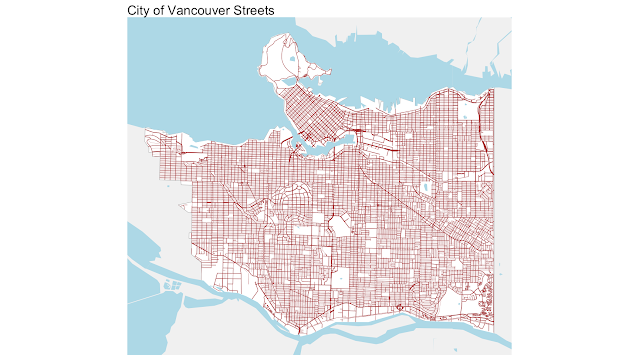

Map of Vancouver, BC streets showing how they are all in a neat grid

Source: Jens von Bergmann https://doodles.mountainmath.ca/blog/2018/06/04/vancouver-streets-and-lanes/

While some might appreciate the order of Vancouver’s streets, I found them boring and uninteresting. The order and regularity of the streets failed to pique my curiosity. I had enjoyed the challenge of navigating Boston’s streets. Indeed, of 100 global cities analyzed by Geoff Boeing, Vancouver showed the fourth-highest spatial orderliness. Meanwhile, Boston sits near the bottom of the list.

I needed a new plan for motivating my running and exercise, which was essential to my well-being. I remembered how years ago, while living in Boston, I accompanied my friend Philip Kreycik on a run around Cambridge, Massachusetts. This wasn't just any run though—it was a run around the borders of the city, and his final run on his quest to run every road in Cambridge. During our run, Phillip explained how running every street had really brought the city alive for him and brought new understanding of how the city worked.
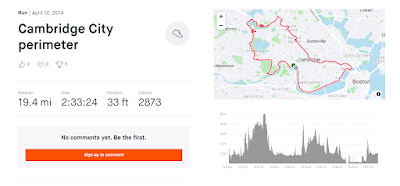
Strava screencapture showing a 19.4 mile run around the border of Cambridge, MA
Map of our perimeter run of Cambridge, MA


Inspired by Philip, perhaps I could do the same in Vancouver?

So I drew on my GIS experience and found some Vancouver street shapefiles, printed out a map of Vancouver's streets, and started my quest to run all of them. This new quest encouraged me to explore, and made each of my runs deliberate, producing new scenery, smells, and adventure—even if all the streets were on a grid.

Each night, I would return to my apartment and use a highlighter to mark the new streets I’d run.


Grayscale map of Vancouver, with streets highlighted in different colors
Closeup of the highlighted map that hung on my bedroom wall

These runs revealed hidden treasures: ripe blackberries, blooming trees, a delicious apple tree, sightings of Black Oystercatchers, or unexpected parks and history.

While I was filling in my map, I was in the midst of working on a review of theories about why people do what they do.  Many of these theories posit the importance of psychological and cognitive needs. One such need that cropped up in many papers was the need for exploration. Though it goes by many names—promotion focus, pleasure promotion, mental mapping—researchers tend to agree on one thing, that it is important to people to explore, to become familiar with the unknown, to chart new territory and connect disjunct sets of knowledge.

Big Leaf maple flowers, showing unfurling red and green leaves and pale yellow flowers
Big Leaf Maple flowers are easy to miss, but worth a second look.

Why was I doing these runs? Satisfying this need for exploration seems to be part of the answer: the excitement of finding what surprises lay on the road ahead or around the next corner, and fitting this new piece of knowledge into my mental jigsaw puzzle of the city. It was fun to see my academic work beginning to explain what I had at first viewed as an entirely orthogonal pursuit.

Just as my academic work was informing my runs, my runs often provided opportunities for academic breakthroughs. What would start out as a break (that I sometimes did not feel like I had time for), turned into an opportunity for deep thinking and reflection. Sometimes, taking a step back—or a sprint forward, as the case may be—was all I needed to bypass a cognitive bottleneck.

Once, while running along Bailie street, I suddenly realized that I had parametrized a beta distribution entirely wrong. Another time, after spending a few hours struggling to write the conclusion for my dissertation, I went out for a run. My dissertation chapters were wide-ranging and interdisciplinary, and finding the higher level contribution that transcended all five chapters was proving difficult. But out on my run, it all suddenly became clear. As I ran, I started writing the conclusion in my head. When I got back to my apartment, all I had to do was transcribe it to my computer.

As 2021 approached, I had run most of the streets near my apartment. Those remaining were quite far away—getting to them was requiring longer and longer runs. As COVID-19 pandemic kept me away from my family’s usual New Year celebration, I decided to kick off 2021 by completing a longstanding personal goal—my first 100 miler. I started at 4pm,  it started raining at 9pm, and by 12:00 AM, it was pouring—a quintessential Vancouver run. Though I was thousands of kilometers away from my family, I felt a sense of belonging as I jogged through these increasingly-familiar streets. Wet, cold, and tired, but home for the holidays.


Map showing 100 mile route
The route of my New Year run

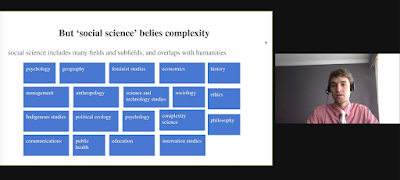
Image shows screen capture of Zoom meeting, showing a slide and a picture of Harold.
A slide from my Zoom dissertation defense. Photo credit: Sophia Winkler-Schor


  On a warm July morning this past summer, I defended my dissertation.  Directly afterward and still filled with elation,  my housemate and fellow runner, Krishanu Sankar, and I dashed out the door and ran south to a road that I had missed in the previous years—the last that I had yet to run: Minto Crescent.

Minto Crescent: my last road!


Only 350 m in length, it marked the end of my quest. I had completed my goal of running all 1557 km of streets in Vancouver and defended my PhD on the same day. They had proven to be a complementary pair of goals.
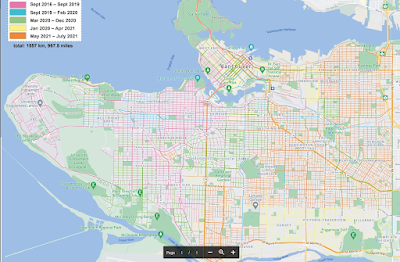


Map of Vancouver showing all the streets highlghted

Map of Vancouver made by Roxanna Delima showing the streets I ran in Vancouver. 


 Unfortunately, the completion of these milestones did not end as I expected. Just a week prior, the man who had inspired this whole endeavor back in Cambridge, Philip Kreycik, went missing in the Bay Area, while out for a run. Searchers would later find his body. I had been looking forward to writing to him and telling him how he had inspired me to run Vancouver's streets, and how thankful I was for this inspiration. His untimely passing made me realize that I should have reached out to him much earlier to celebrate the journey, instead of waiting until I’d finished. 


Ink drawing of a bird hanging upside down and looking at the viewer
Bushtits were frequent companions on my runs.


As I reflect on my experience a few months later, I’m struck with how essential this running journey was to my PhD: it provided a perfect complement to the often-stressful graduate experience. I am thankful for the incredible encouragement I had throughout my PhD and while running all the streets in Vancouver. I have also come to appreciate the importance of cherishing whatever place I’m situated in, and learning to look past the gridded map to see the beauty of the individual trees, streets, and neighborhoods.


Creative Commons Licence
CHANS Lab Views by Kai Chan's lab is licensed under a Creative Commons Attribution-ShareAlike 4.0 International License.
Based on a work at https://chanslabviews.blogspot.com.

Friday, June 18, 2021

Make COVID-19 Vaccination Mandatory at Universities?

By Kai Chan [Improved 2021.6.19]

With COVID vaccine policy, Canadian governments and universities risk sleeping at the wheel, unfairly endangering vulnerable individuals in the name of a wrong-headed protection of personal freedoms. Governing effectively might—but doesn't necessarily—mean mandating vaccination.

As we contemplate finally returning to in-person instruction, now is the time to make this right.

Governments have been reticent to mandate vaccinations. For example, B.C.'s Return-to-Campus Primer states that “The COVID-19 vaccine will not be mandatory.” A recent editorial in the Globe and Mail argues forcefully against this policy, pointing out that "there is no constitutional right to put other people’s health at risk."
British Columbia's "Return-to-Campus
Primer"
: "The COVID-19 vaccine will
not be mandatory"


As a university professor, I've seen these dramas play out first hand. I've had students contract long-COVID, and almost fail out of my course. One student was in tears for an hour as we tried to work out a plan to complete the course.

And that was not a case contracted in class. I teach a course where students are expected to attend class and to participate (last year was on Zoom). Their grades depend on it. Sure, most students will probably get vaccinated, but some will choose not to. Imagine three hypothetical students.

A is unable to get the vaccine, perhaps due to severe allergies to vaccine components or—worse—due to an autoimmune disease that also puts them at additional risk should they contract COVID. They are extremely careful about their own exposure and are deathly afraid to go to any indoor place where some people are unvaccinated (and not nearly as careful as they are).

B is able to get the vaccine, but lives with immunocompromised individuals (perhaps like A), who are understandably hyper-vigilant about any source of exposure to COVID. B understands that the vaccine provides a strong degree of protection against them getting severely sick with COVID, but they worry about the unquantified risk that they might pass COVID from classmates to others, perhaps even without getting symptoms.

British Columbia's Guidelines document
doesn't even mention "vaccine".

C
is a healthy young adult. They're not afraid of COVID, and they won't get the vaccine. Perhaps they think (contrary to abundant and diverse forms of evidence) that COVID is just a conspiracy. Perhaps they have been told that they need to trust in God's will to protect them, rather than vaccines. Because they are not afraid, they're not at all careful about limiting their own exposure.

Is it fair that C should be able to subject A and B (and their families and friends) to the risk of COVID-19 in the classroom?

I don't think so. And at first, I couldn't see how anyone could argue otherwise. (This was a classic case of cultural cognition, by which my views were inordinately shaped by those I was reading and hearing.) But there are worthy counter-arguments. 

The first is that it is unfair for a government to force an individual to do something that entails side-effects and risks. Vaccination does have risks. Some of the rare side-effects don't emerge until after a large-scale roll-out, like the current concerns about rare heart inflammation associated with Pfizer in young people (fortunately most have recovered quickly, with no apparent deaths). So, on fairness, the arguments for mandatory vs. voluntary vaccination seems to depend on cultural context and political leaning.

Second, there is very little vaccine hesitancy here, and early polls suggested that most people didn't favour mandatory vaccination (only 39% of Canadians did in late 2020; although with vaccine-hesitancy shrinking, views about mandatory vaccination may also be changing). In this context, it's important to consider (a) effective alternatives to mandatory policies; (b) back-fire effects, where anti-vax folks might double-down on their position and cheat (e.g., Savulescu 2020); and (c) blowback in the form of widespread resentment of mandating authorities (e.g., Meier et al. 2019). Risks of back-fire and blow-back are substantial in some contexts (although fortunately, vaccine polarization in Canada is not like the US). 

So let's consider some alternatives to mandatory vaccination. One possibility is that individuals could be left to enforce a social contract by pressuring each other to get vaccinated (e.g., Korn et al. 2020). This might sound attractive. But this means governments leaving the burden of persuasion on the vulnerable and the proactive. To me, that sounds like governments reneging on their responsibility to govern.

A second possibility is incentives, offering rewards for vaccination. There's a question of fairness here, though, with any incentive program that only targets new vaccination once most of the population is vaccinated. Why should the hold-outs get rewarded? This also risks encouraging people to wait until rewards are offered. If instead everyone gets a reward, it's costly. And by rewarding people for basic pro-social actions, we may undermine altruistic and civic motivations.

A third possibility is to shift the default (a form of 'nudge'). Make it expected (not mandatory) for students to be vaccinated. Those who can't be vaccinated safely can supply a doctor's note, etc. Those who don't wish to be vaccinated can show up to provide their reasons for health officials. The decision can be automatic (e.g., without judgement about legitimacy). As long as we shift the burden of effort to those seeking not to be vaccinated, we reflect public priorities for herd immunity in the choice structure that individuals face.

If people requesting exemption have to show up to a vaccine clinic, this solution might be even more elegant. Resistant folks would be surrounded by folks getting vaccinated, and they could change their mind at the last moment to receive a vaccine instead.

For public policy, the choice isn't simply between mandatory vs. purely voluntary. There are other smart alternatives that might be both fair and effective (particularly switching the default).

This is a message for every province, and for every university where provincial governments continue to sleep at the wheel.

Don't mistake a purely voluntary approach for a good solution. It's just the easy one, not the right one.

If you found value in or agree with this post, please share it widely. KC

PS, Following the publication of this post, in August 2021, UBC introduced a kind of vaccination mandate just like that called for here, which required students, staff, and faculty members to undergo frequent rapid testing unless they were fully vaccinated. (I'm not claiming credit.) This policy appears to have contributed to the vast majority of the UBC community getting vaccinated, even though the enforcement of rapid testing protocols was very slow to follow.

Friday, June 11, 2021

Let’s Talk about Complex Chronic Illness and Academia

By Kai Chan

Yesterday, a subset of my lab group (<10 people) had a gathering on the beach for the first time since COVID began. I wasn’t among them.


The normal way to interpret this is to assume that I don’t care that much about them, that I don’t really enjoy being around them.


Nothing could be further from the truth. I love these people. They’re brilliant, generous, creative, inspiring people that I’ve gone out of my way to surround myself with. I cherish the time I get to spend with them.


So, why did I miss the gathering? Because my wife had a really bad week.


Sounds lame, doesn’t it? The words wither in my mouth as I spoke them, by way of a quick explanation for my absence.


This blog post is the longer explanation, the one I realized I had to give. It explains a whole bunch of events I’ve skipped, tasks I have begged off, deadlines I’ve missed.


Let’s try that sentence again: (because) the woman I love and the mother of my children is suffering. Chronically, and last week was especially bad. For years I made it worse by pushing her when she had nothing more to give. No more.


The suffering is hard to understand from the outside. And for those who suffer, the feeling of shame that folks just don’t get it—even close friends and family—just adds to the misery.

chaya.goldberger, Flickr


The family of conditions are called “complex chronic syndromes”. They include myeloencephalitis/chronic fatigue syndrome, multiple chemical sensitivities (MCS), fibromyalgia (sometimes called chronic pain syndrome). With permission, I’ll share that in my wife’s case it’s quite likely fibromyalgia, perhaps with systemic mold toxicity, explained partly by uncommon genetic predispositions. That’s the medical speak, the jargon.


On a human level, this manifests in an unceasing world of fog, incapacity, and hurt. It’s a body reliving past traumas—physical and otherwise—in an endless self-reinforcing cycle. It’s somewhat like having a flu and never shaking it. You still feel off, listless, achy, painfully tired, and out-of-it mentally. People think the pain is the worst of it, but that’s not my wife’s experience. The mental fog is the worst, and the anxious buzz. The pain seems most troublesome because of how it undermines sleep, which seems absolutely crucial for coping and any chance of recovery.


It’s so bad that many chronic sufferers can’t do most of what they used to do. My wife can’t work any longer. She can barely get up to function for appointments that start at 11:30am. One appointment is about all that she can manage in a day, they tax her so much. It’s hard to imagine recovering at that rate, given how many appointments seem necessary when so many things are off.


The biggest blow is almost certainly to one’s sense of self as a capable person. It’s one thing to be sick for a while, and get better. It’s another thing entirely to be so sick that you can’t do most anything, with no clear route to recovery. She will get better—I believe it firmly. But in the meantime, her incapacity gets in her head, dangerously.


And that kind of danger I can’t take lightly.


So life just isn’t the same—for me, either. I always shared child-rearing duties quite equally, and took pleasure in that. But whereas school drop-offs used to be shared, now that plus breakfasts are all mine. Ditto for cooking dinner (after my wife does dinner prep while I work), and bed-time routines—every night. I have 9-5pm on workdays for work; outside that, I’m primary parent >95% of the time.


Travelling used to be a big part of my job, but those days are long gone. When I travelled, I would work like a demon, cranking out 15+ hour days even while also juggling security checks, customs lines, and the rest. That was the only way I could keep up. I haven’t had a ten-plus-hour work day since March 5 2020, when I spent a solid seven hours on a whole-brain task and also cleared out hundreds of emails, including some complex ones. It’s crazy that I miss it.


I don’t need a pity party. My wife is the one who's suffering. (She just wants doctors to stop saying or suggesting that it's all in her head.) I have a few colleagues who are single-parenting, and what I’m going through is not close to that. My wife still does a lot, and she is there to balance out my heavy-handedness and all my other parenting foibles. Plus she’s there for me when I need her.


from Flickr

I used to think that meant that I could travel, and she’d rally. And she did. Before I understood her condition—before either of us did—I thought this was OK. I’d have a work trip on the horizon. As my departure approached, she would grow increasingly anxious about coping without me. Inevitably, she would lash out, and I’d get defensive at the perceived guilt trip. We’d argue for days. When I would return, she’d be sapped, but she would have made it.


“What doesn’t kill you makes you stronger,” they say. I don’t think they suffered from a complex chronic illness.


These trials certainly didn’t seem to be making my wife stronger. The knowledge that she had made it through before was no comfort next time around. If anything, the anxiety was worse.


I’m done making it all worse. I don’t want to see how far she can be pushed. I want to make space for her to get better.

—

This post deepens my understanding of achieving balance in academia, which I reflected on in the following three posts from 2015:

Creative Commons Licence
CHANS Lab Views by Kai Chan's lab is licensed under a Creative Commons Attribution-ShareAlike 4.0 International License.
Based on a work at https://chanslabviews.blogspot.com.

Wednesday, May 19, 2021

It’s a bird, it’s a plane -- it’s a bat!


By Julia Craig, Masters student

View over Lost Lagoon, Stanley Park


Not every master’s thesis makes you feel like a comic book hero. Yet as I strap on my helmet and vest and emerge from my basement apartment, I feel like Batman suiting up and zooming out of the bat cave. Admittedly, there are some differences. Unlike Bruce Wayne, I lack a tragic back story. Oh, and I have to get by on a graduate student’s budget, rather than a billionaire’s. Ultimately however, we share the key qualities that make a comic book hero: we both have cool gadgets, a sweet ride, and a self-mandated mission to protect the citizens bats of Gotham City Vancouver. 

My stealthy mode of transportation is an eco-friendly batmobike. It features several high-tech gadgets including an ultrasonic acoustic detector and microphone on a pole (a lot cooler than it looks) and several low-tech solutions like audio dampening devices (which others might call “pieces of cardboard that block noise from my brakes”). The appearance is as striking as the batmobile--but for entirely different reasons. I often get odd looks from passersby. Maybe they’re also expecting a tinfoil helmet? But here function is more important than form: the batmobike lets me eavesdrop on bats.


Diagram of the Batmobike, drawn by Julia Craig


Like all biology students, I yearn to peek into the lives of animals. In this case, bats. I can’t actually translate bat conversations (yet), but I can tell which bats are present.

There are actually bats in Vancouver— as many as 8 different species, according to a preliminary study. Year after year, they return from a winter-long hibernation to their favourite summer roosts around the city; in tree hollows, abandoned buildings, attics and bat boxes. 

In fact, they’ve been here for generations. Much like humans, bats have long enjoyed living in river valleys, wetlands, and deltas, where there’s fresh water and warm nights. They become so attached to their summer residences that they have found ways to remain even as cities were built up around them. Indeed, they don’t have many other options in BC as much of their ideal habitat is regularly logged or developed for agriculture and industry. This loss of habitat is a primary threat for the many bats at risk in BC.

Protecting these species involves learning how to coexist with them—even in cities. First, we need to know what animals like about our cities to begin with. 

Although bats share our city and live amongst us, we know surprising little about them. Birds advertise themselves in plain sight. Bats, on the other hand, hide during the day. And when they emerge at night, they call at a frequency that people can’t hear. How they use the city is a mystery—for now.

Bats can be distinguished from birds at twilight by their agile and unpredictable flight patterns


Cue the batmobike. Using an ultrasonic detector and riding around the city at night, I hope to catch glimpse into where bats are. From other studies that monitored bat activity, I have some idea of where bats may like to hang out. For example, they often prefer one-stop destinations like ponds where they can easily grab dinner and a drink.

Vancouver, however, is one of the greenest cities in the world, with parks of all sizes, surrounded by a bay and a river, with greenways and trails that run through or by them all. Will bats use these varied landscape features for foraging or as connections to other parts of the city? Or will they stay only in the most “natural” areas? Are there differences between bat species: do they form cliques, with all the artsy little browns hanging out by the river or sporty California myotis foraging by the beach?

These kinds of studies (called “mobile transects”) are often done with cars, but I have chosen to use a bike as it is better suited to the city. With a bike, I can transverse the city on its many greenways, roll through parks on gravel paths, and ride through forests on dirt trails, or by ponds on golf courses. In theory, I will get a pretty complete picture of where bats are in the city. Perhaps batmobikes will become more common practice in the future, with enough velophile grad students!

Stay tuned to discover with me the secret lives of bats! 


Creative Commons Licence