Saturday, September 12, 2020

Ecosystem Services Research: Is it up to the challenge?

Re-blogged from RELATIONAL THINKING, The People and Nature Blog
Kai Chan and Terre Satterfield

In this post Kai Chan and Terre Satterfield discuss the evolution of ecosystem services research and what it next has in store. Read more in their new research in People and Nature ‘The maturation of ecosystem services: Social and policy research expands, but whither biophysically informed valuation?

Over the span of three decades, ecosystem services research has gone from a twinkle in an eye to a dominant way of viewing human-nature relationships and the many constituent ecological and social benefits and consequences that might follow. That twinkle is today a prominent international science-policy platform (IPBES) with increasing conduits for ecosystem services research into decision-making at all scales in many nations. But is there a broad base of appropriate research to support just and effective decision-making? And has the field really benefited from central ideas across the natural and social sciences? ... (read more here)

Creative Commons Licence
CHANS Lab Views by Kai Chan's lab is licensed under a Creative Commons Attribution-ShareAlike 4.0 International License.
Based on a work at https://chanslabviews.blogspot.com.

Wednesday, September 9, 2020

Structural classism in Canadian public research funding

By: Maayan Kreitzman


It’s once again scholarship-application season, when we get plied with emails from the Canadian government about funding competitions for graduate school. And, while I’m no longer eligible for graduate student scholarships and am thus freed of feeling bad about failing to get them, I can however, still feel bad. That’s because these awards, and by extension the Canadian public research funding system as a whole, are pretty damn terrible. This blog post will explain why.


Like many others in academia, our lab group and department have been jolted into a conversation about the racist systems of oppression alive in our departments and institutions of late. The Black Lives Matter movement has made it impossible to look away from some of the most egregious and violent examples of racism and oppression in our society, but it has also turned the lens inward to the seemingly progressive spaces where we conduct our scholarship. Due to the initiative of our students society (and a few professors as well), and students within our lab group, we’ve been having more conversations about this topic lately - through monthly lab meetings about anti-racism, through establishing a departmental anti-racism working group, and through the recent proposal for funding from the President’s office for a staff person to analyse racism and inclusion in our department (more on this in a future post). These are welcome developments that have allowed for franker and more challenging discussions to take place about recruitment, retention, and resource allocation than I have previously experienced during my six years here. And, though I and many others have been critical of Canada’s approach to funding research for years, these recent conversations throw an even brighter and less flattering light on the advent of scholarship application season.  


The Canadian public system for funding research follows similar logic from bottom to top: Money = prestige and excellence. Large bundles of money = large bundles of prestige and excellence. The funding system is characterized by programs with huge and illogical jumps in funding levels between one tier and the next or between programs, from graduate scholarships which are stratified into three tiers (21k/yr, 35k/yr, and 50k/yr) to research chairmanships which are stratified into several tiers within various programs (100k/yr and 200k/yr for “regular” Canada Research Chairs, 350k/yr and 1 million/yr for “Canada 150 Research Chairs” and up to 1.4 million for “Canada Excellence Research Chairs”). For example, the 2017 announcement of 117.6 million dollars for a new Canada 150 Research Chair program promised to spend five to ten million dollars each on a handful of foreign imports. Again, a “normal” tier 1 Canada Research Chair is worth 200k/year, even though these are themselves extremely prestigious and competitive. The same goes for the Vanier scholarships for PhD students, which are $29 k/year more than a “normal” PhD scholarship.  


What is the logic of these massive differences in funding levels? Certainly, few people would dispute that differences in experience, career stage, and impact of contributions justify differences in compensation. And that different research programs have different funding needs for technical reasons. But how large should these differences be, and at what point do they amplify rather than reflect differences? Some will say that brilliant people really are worth more than others, and in order to compete for smart people with other sectors and other countries, funding must be competitive, lest they go elsewhere. Moreover, once you’ve found these rare and brilliant individuals, the more money you throw at them, the more brilliant results you will get. But, is there any evidence to support this theory? As far as graduate students in our department go, people that are allowed to apply for the highest level of funding (Vanier scholarships) through the department have already committed to a supervisor and a program. They aren’t shopping around anymore by the time they apply. This suggests that while the extra money is certainly nice, it is not actually functioning to attract bright students - something else is. 


The victims of the research chair and graduate funding  programs are not the same. In the case of the highest tier of the Canada Research Chairs program (the “Canada excellence research chairs” - a moniker I can’t seem to type without scare quotes and an eyeroll), the worst outcome is a waste of public money for proportionally small productivity gains as millions are committed to one individual’s salary and research program. In the case of the graduate student program, the issue is not so much money wasted on the highest levels of scholarships (which actually embody a decent living wage), but the fact that the “normal” tier of support results in actual poverty: 21,000 dollar/year PhD stipends, and 17500 per year for MSc students, a truly impossible amount to live on (and even less than recipients of CERB can expect to receive in a year as emergency living income). Take, for example, a student living in Vancouver or Toronto, who might expect to pay $800 for a bedroom in a house with four or more other students as roommates. In Canada, you're considered to live in "housing poverty" if you spend more than 30% of your income on rent. So at $9,600 per year spent on rent, both the PhD and Master's students are in *acute* housing poverty, spending 50% or more of their total income on rent, even with multiple roommates. (And let’s remember, these are the rates paid to students who are competitive enough to win NSCERC/SSHRC scholarships. For those that don’t make the cut, or for international students who don’t qualify, UBC’s baseline PhD funding is $18,000/year, and there is NO guaranteed funding for Master's students). So though their outcomes are different, the steep jumps between levels for both student scholarships and research chairs send a similar message: good people are scarce commodities, and the best people are worth two to 20 times as much as their colleagues. 


On top of this stratification, is the fact that government awards are likely to be given to people that already have plenty of experience and awards. This is the literal policy of NSERC granting committees for both graduate scholarships and chairs - if you or your institution have received NSERC funding in the past, you’re more qualified to receive more in the future. This stacking means that the people most likely to receive the added prestige and money are the ones that already have plenty of experience and social capital. Thus, they can stockpile awards and prizes, while others with less experience who might actually benefit more from funding and recognition are not considered competitive. This leads to a calcified “rich get richer'' dynamic which disadvantages people that come from weaker socioeconomic backgrounds or smaller institutions, with all the ramifications thereof on the diversity of people producing research. 


The top-heavy hierarchy of funding coupled with the stacking functions of who gets these awards not only fails from an equity perspective, it also fails to actually analyse the optimal distribution of funds from the perspective of outcomes and public benefit. Is the added productivity of giving someone who already has structural advantages extra money more than the added productivity of someone who does not have as good a CV or as much experience getting that money? What about the efficiency of giving large bundles to high-profile research groups (i.e., Canada 150 Chairs) vs spreading it in smaller bundles (i.e., the NSERC discovery grant)? How do these dynamics differ for research funding versus salary funding? What thresholds are reasonable for baseline funding and what are the optimal intervals for signalling meritocratic achievement at various career stages? Should graduate students and junior researchers be treated as actual workers, or as apprentices who get some temporary hard knocks, and are rewarded for it later? These questions, while subjective in part, could actually be answered through analysis of program dollars, dropout rates, research outcomes, and other available data in various fields and at various career stages - analysis which I do not think Canada’s funding agencies have done. They could also be answered without much technocratic analysis simply through an articulation of culture and values that the Canadian public system holds and wishes to promote - for example the values that nobody should live below the poverty line, that talent should be nurtured and retained rather than just attracted externally, and that success and prestige are not signalled chiefly through huge jumps in funding. 


Clearly, these are not the values our system currently promotes. Its excessively bundled and hierarchical programs perpetuate a situation where money and prestige are one and the same, wasting money in some cases and depriving individuals and research groups of the modest funding they need to thrive in others. Spending so much on individual researchers that have the extraordinary good luck/ monomania of thriving in the current system in the hopes that Canada nabs one before they win a Nobel prize sends the message that some people need to be exorbitantly bribed to be here while others who choose to stay in the first place must compete over scraps. This value logic perversely wastes money on importing or “competing” with other sectors for talent rather than actually growing, stewarding and retaining talented people that truly want to call Canada home. 


A competing theory for how to have good research is that there is no lack of brilliance coming in the door, but there is a lack of stewardship and retention of that talent. There are people who, because they aren’t automatons, become exhausted and disillusioned with the competitive economy of prestige in academia and leave. It is customary to regard these dropouts as failures that perhaps wouldn’t have come to much anyway. But what if they are academia’s most valuable wasted resource? Perhaps altogether even more valuable than all the brains that have drained away to other countries (or chose to remain there) for their higher compensation packages? Even in IRES, a program that has a lot to be proud of in terms of student and faculty diversity, recent discussions in the Anti-Racism Working Group have shed light on the fact that we often experience attrition among First Nations students. Furthermore, while IRES has strong representation in terms of international scholars, we have a comparatively poor track record for attracting and retaining the people who are most dispossessed and marginalized here in Canada: Indigenous and Black North American students. Surely this is not due to any racial or cultural propensity toward failure - rather, it means that there is something about our program, our institution, and/or our funding structures (to say nothing of our society at large) that is not enabling everyone to thrive equally. Perhaps some of these people, as well as many non-marginalized folks, would be happy and productive with a livable wage, a modest amount of research funding that was more spread around and some balance in life.  


Canadian public funding should envision and enact a culture of dignity for all (including international students that do not come with wealth), frugality for those who have been over-funded in the past, and recognition for outstanding contributions that is not as closely linked to massive differences in funding. If signalling prestige is important to differentiate people and attract talent, why not do so with much smaller bonuses in funding or by decoupling the two completely? Perhaps the most outstanding students and researchers should get an extra thousand or two dollars as a prize? Or, perhaps they could get a plaque that says “CONGRATULATIONS, YOU WON ACADEMIA”. Some great research is fairly inexpensive; some mediocre research costs a lot. There are real differences in needs and priorities that the allocation of money must reflect. But the size of your paycheck or budget is not the best signifier of quality and achievement, and should not be used as such. 


To situate myself in this, I write not from a place of personal bitterness, but rather from an understanding how my privilege has functioned in a system that has been ok for me in a way that isn’t true for many others. The public funding I received, a competitive NSERC fellowship, but at the lowest tier of PhD funding that Canada offers, combined with TAships was about enough to cover my fairly modest needs (i.e., roommates well into my 30s, no kids, shopping second hand)  for 5 years of my PhD (the final year was funded through an external grant). But the only way I was comfortable existing on that salary was because I had the cushion of a large savings account courtesy of coming from a family that has money, and more recently because of having a partner who makes significantly more than the median Canadian income. Even though I could technically survive on the funding I received, I also had connections, close nearby family, and a native language that made everything easier. I never had to worry about what would happen in an emergency. If I didn’t have these class privileges to give me peace of mind, graduate school would have been a different, and much more stressful story. 


As a public entity, the tri-council system has an enormous responsibility to shape conditions for a healthy academic sector that serves Canadians. It could do so much better.


Acknowledgements: Many thanks to Jo Fitzgibbons who contributed information about the IRES Anti-racism Working Group's findings, and provided helpful comments and edits, to Anna Santo for helpful comments and edits, and to Kai Chan for discussion and background.


Creative Commons Licence
CHANS Lab Views by Kai Chan's lab is licensed under a Creative Commons Attribution-ShareAlike 4.0 International License.
Based on a work at https://chanslabviews.blogspot.com.

Wednesday, August 12, 2020

Push for Science in Policy through IPBES: Here's How to Get Started

Part of a series of posts about IPBES (the UN's Intergovernmental Science-Policy Platform on Biodiversity and Ecosystem Services) and an inside look at its processes. More to come.

Perhaps you were compelled by the global biodiversity crisis laid out in the IPBES* Global Assessment, or inspired by its bold call for transformative change. Or maybe you've been impressed by all the news coverage, or the prominent recognition of the importance of diverse ways of knowing. If you are like the Zoom full of people who attended a recent conference session about IPBES**, one way or another you realize that IPBES is every bit as powerful and needed as its older sibling (IPCC***).

And you wonder how to get involved. This post is intended to guide you.


1. Get to know (some of the work of) IPBES. This includes a variety of assessments (Global, Regional, Land Degradation, Pollination), as well as other reports (e.g., about models, scenarios and values). For an introduction to the Global Assessment, its key points, and how to cite different pieces, see this post.

Beyond these technical pieces, though, there are increasingly accessible ways to get to know IPBES. Follow @IPBES on Twitter. Listen to the new IPBES podcast series, Nature Insight. Frequent the website, and read guest articles (like A million threatened species? Thirteen questions and answers and What Is Transformative Change, and How Do We Achieve It?).

2. Review IPBES products. Any researcher or policymaker (including students) can sign up as reviewers. You can review draft chapters, or even scoping reports (which set the stage for future assessments—including the proposed Transformative Change Assessment). To see what's open for review, follow IPBES notifications here. Here are some tips about reviewing:

(a) Don't be afraid to say, "This is confusing". IPBES products are intended to be accessible. If you're interested, and you don't understand, that's a problem (and not your problem).

(b) Think about what's there and what's not (but should be). It's easy to critique the text that's present, but also think about what else should be included.

(c) Evaluate the flow of ideas. These documents are not always easy to follow, but they should be. Many reviewers attend to particular pieces, and not how the whole fits together. The whole is important.

(d) Don't get stuck word-smithing. A little of this is welcome, but the words used are often highly constrained, so much critique here would be a waste of everyone's time.

3. (If you're early-career) Apply to be an IPBES Fellow. This is a superb program, with an international network of brilliant, interesting people.

4. (If you're established in your career) Apply to be an Expert in a scoping or assessment process. As above, see notifications here.

As I note, I started out a skeptic about IPBES. But I've become convinced that it's desperately needed and making crucial contributions to science and policy about nature and people, shining a light on the ecological crisis and possible ways out of it.

*IPBES stands for the UN's Intergovernmental Science-Policy Platform on Biodiversity and Ecosystem Services.
**This post synthesizes answers provided by Patty BalvaneraMarla EmeryDoug BeardJeannine Cavender-Bares, and myself at the ESA Annual Meeting in 2020.
***IPCC stands for the UN's Intergovernmental Panel on Climate Change.

Tuesday, July 28, 2020

Author Contributions? Epic Fail, or Relational Success

By Kai Chan for CHANS Lab Views

This is (an extra) part of a series, How to Write a Winning Proposal—in 10 Hard Steps (why Author Contributions at the proposal stage? Because you need to think about these issues early: read on!)


Who did what? Who deserves the real credit, and who came along for the ride? Who contributed what %?

Author Contributions statements for papers, theses, and tenure files are far more important than they might seem. Writing these little statements well is also far more difficult than it appears. I learned this the hard way, with an epic fail at one of the most important junctures of my professional career.

This difficulty isn’t helped by understandable but mistaken notions that these statements are about the ‘real credit’ or percent contributions.

I was going up for promotion—a crucial moment in an academic’s career. My director, who had to write the crucial departmental letter that would accompany my file to the higher levels at the university, was also a coauthor on one of the articles I submitted. I was directed to write a statement clarifying my contributions to the papers. I interpreted it as “Show that this was mostly your work—that you brought the key ingredients, not your coauthors”. Error #1.

My director/coauthor flagged a concern. Ouch. I reread the statement to understand. It started with my contributions, and followed with my coauthor’s, almost as if these were an afterthought barely worth mentioning. I also averaged-up—that is, if I felt I did most of a task (e.g., designing the analysis), I assigned it to myself. E.g., “I designed and executed the analysis, I wrote the paper. My coauthor edited.” Now imagining my coauthor’s perspective, my heart surged, my face flushed, and shame and disgust washed over me. What I wrote wasn't false, but it was certainly not an equal representation of both sets of contributions. It oriented around mine, because that's how I understood the task (wrongly).

The irony was palpable. I had already become excited about relational values (preferences, principles and virtues associated with human relationships involving nature; see also here), and I had been consciously thinking relationally in general. That is, I had been thinking first about how actions reflected and built appropriate relationships, and only second how they yielded positive or negative consequences. Here, I clearly failed: I had unconsciously treated the authorship statement as a means to the end of impressing reviewers, entirely missing their crucial contributions to building or eroding the relationships I sought with cherished colleagues.

Ugh.

One might think, following such a teachable moment of shame, that I would have written flawless Author Contributions statements ever since. I wish I could say that were true. I don’t normally make the same mistake twice, but Author Contribution statements are full of ways to fail.

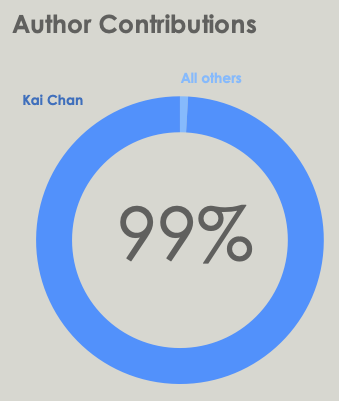
If we think of the hours spent directly on the manuscript,
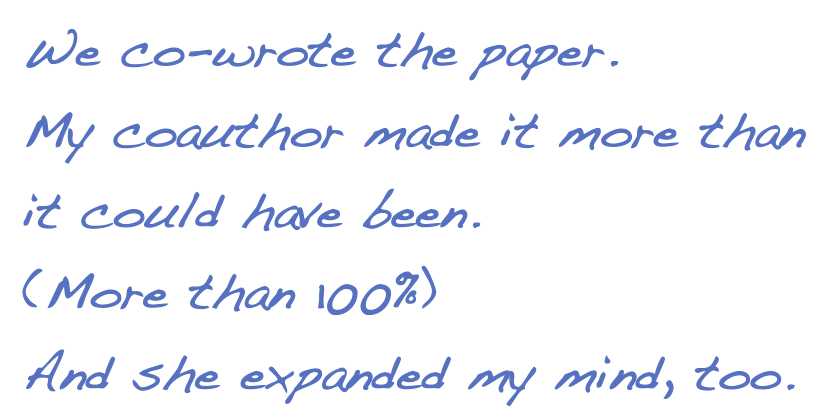
we may think like this. But that doesn't tell the full story.


More recently, the same cherished coauthor and I were wrapping up a paper many years in the making (almost a decade). Finally, it was time to write an author contributions statement. I was conscious to err on the side of generosity. I listed our contributions together (not mine first). I emphasized shared contributions to tasks wherever it seemed appropriate. But by my recollection, I had approached my coauthor with the idea, and indeed, with a draft of what I felt we needed to say, and she had responded to that. So, I wrote something like, “KC wrote the first draft.”

It was déjà vu when my coauthor responded with edits and comments, with her recollection that we co-wrote the first draft. My coauthor pointed out that it had been her idea to include an empirical component at all. I had started counting ‘first draft’ from even before there had been an empirical component (which was now the central identity of the paper). The paper sure was different back then, without its central contribution. Point taken, absolutely we co-wrote the first real draft of the current paper.

Worse, though, my mind full of the many hundreds of hours that I spent coding papers and refining the analysis without troubling my coauthor, I claimed credit for designing the analysis. She contested that, politely and respectfully, as always. When I wrote the statement, I didn’t even remember that it had been my coauthor’s idea to do an analysis, and indeed that we had discussed some of the major codes right at the outset. It wasn’t a long, involved or contentious conversation, so it didn’t even spring to mind. But it clearly structured everything that followed.

Double ugh.

This time, I had been thinking consciously with the lessons from last time. I had thought I was being generous. But my thinking was skewed by my memory, which was rooted in hours spent and emotion-laden moments as indicators of contributions. Key structural conversations from many years ago were overlooked.

It’s so much easier to remember one’s own contributions than others. I think in our own minds, others’ contributions often become momentary guidance in a journey that we travelled mostly solo.

Subconsciously, I was thinking about percent contributions as hours spent on the paper. In contrast, I had consciously brought my coauthor on board because I knew that she would leverage countless hours of her reading and thinking of different but complementary literatures into a focused contribution on the manuscript. And I knew that this focused contribution might enable the paper to be rich and beautiful.

I’ve also had experiences on the other side, of course, because I think it’s hardest for students to see their supervisor’s contributions because they structure what follows. One wonderful student had joined me to do a project that I had envisioned well before the student’s degree. He had first written about my contributions as the same as other coauthors (e.g., editing drafts). These other coauthors were ones I had suggested as committee members, while helping this student envision what the project could look like and how it could make a great contribution to the literature and to problems that we both seemed to care about (based on his Critical Ingredients document). He didn’t mean to diminish my contributions, they just weren’t that visible to him, because they were so structural as to be part of the context.

I had another student—among the most principled, fairest people I know—who wrote that she ‘wrote the paper’. The paper was a Google doc with a bunch of notes when she invited myself and a coauthor in to give it structure, direction, themes, and relevant literatures. Yes, she typed most of the words, and of course she led the project and clearly deserves first authorship. But for me, ‘wrote the paper’ now means ‘gave shape to the main ideas in a complete good draft’.

The whole notion of percent contributions makes zero sense to me, even though it’s explicitly requested by some journals and grant agencies (others are more progressive, e.g., CRediT, the Contributor Roles Taxonomy). There is no single dimension by which one can measure author contributions on a paper. A paper should be more than the sum of the parts; coauthorship shouldn’t replace work, but rather shape the whole paper.

Coauthorship therefore shouldn’t be measured in time spent, but our memories lead us that way.

Good notes are crucial here, to record others’ contributions along the way. Then can we write Author Contribution statements that reflect how a paper is a beautiful symphony of ideas from a team.

A great strategy, which can avoid a lot of awkwardness, is to discuss or specify the responsibilities at the outset. Personally, I generally avoid pre-structuring contributions so as to maintain an organic adaptive process, but it’s great to discuss the options.

Then we can write statements that depict research as a deeply relational process, and which further build these collaborative relationships as being of more than instrumental value.


Creative Commons Licence
CHANS Lab Views by Kai Chan's lab is licensed under a Creative Commons Attribution-ShareAlike 4.0 International License.
Based on a work at https://chanslabviews.blogspot.com.

Friday, July 24, 2020

Distilling and discussing the IPBES levers & leverage points for transformative change

14 months ago 132 nations agreed upon the pathways to sustainability. 

   These are the Levers and Leverage Points of the @IPBES #GlobalAssessment 

   They are far more provocative than they seem. This new paper in People and Nature explains why: https://besjournals.onlinelibrary.wiley.com/doi/10.1002/pan3.10124


Several accompanying pieces make different points:

  1. Our blog response to Peter Bridgewater, handling editor at PaN.
  2. My story in The Conversation
  3. An IPBES podcast, which just aired on Wed.


Please share with potentially interested parties. If we’re going to re-orient societal efforts towards transformative change and sustainability, we will need agreement on how, and that it’s needed.


Why is this in People and Nature? As a Lead Editor, I have seen firsthand the excellent work done by my colleagues there. We are collectively working towards transformative change in academic publishing. It offers precisely what my coauthors and I sought: deep interdisciplinarity and consistently thoughtful reviewing and editing. Peter’s blog (above) offers a glimpse of how we were pushed in all kinds of productive ways. In a few weeks, I’ll also share a paper Terre Satterfield and I have been working on for 8 years, also in PaN.


Creative Commons Licence
CHANS Lab Views by Kai Chan's lab is licensed under a Creative Commons Attribution-ShareAlike 4.0 International License.
Based on a work at https://chanslabviews.blogspot.com.

Monday, July 6, 2020

Why Some PhD Courses Shouldn't Have Grades

Kai Chan for CHANS Lab Views

This is part of a series, How to Write a Winning Proposal—in 10 Hard Steps


This past semester, I had the great pleasure to re-design and teach our program’s core PhD course (RES 602; see Intro to this series). I bucked many years of history with my reimagined grading policy for the course, which is to effectively replace grading with  individualized feedback. I told the students that they would all receive ‘A’s if they did the work and put in a genuine effort. Here’s why.


First, some context: in this course on “Interdisciplinary Research Design for Sustainability Impact”, the whole purpose is to coach students to become rigorous, insightful, impactful researchers. Thus, students’ and their own work are at the centre. And these are diverse students: all interdisciplinary to some degree, but in vastly different ways. Some primarily in the physical or natural sciences, some in the social sciences and humanities. Some do largely qualitative work, while most do some quantitative research. They straddle different epistemologies, and they adhere to radically different theories of change.


In a nutshell, there are seven classes of reasons for my grading policy that ‘A’ is the default.


1. The students are all on their own journeys, doing radically different kinds of research in different academic traditions, with different standards of evaluation. Some of these I know well, others I’m still just learning. → I can’t equally judge them all.


2. I have my own positionality in all of this. I’m more excited by some kinds of questions and approaches than others. → It’s therefore key to decouple my feedback from measures of performance that will go on students’ records.


3. The spectre of having to provide defensible grades to all would substantially shift my teaching towards a different set of uniform assignments. By their uniformity, such assignments could never properly equip a diverse class of students to do their own projects. Moreover, assigning (and justifying) numeric grades is time-consuming and detracts from the time I can spend giving tailored feedback. → Freedom from grades enables me to make different contributions to different students.


4. We don’t actually need grades for any real purpose at this stage. They simply serve to let people know that students are on track (or not). Other times, what students really need is a letter of recommendation. I can write a detailed letter for all of the students without needing to rely on grades. → Why perpetuate an ill-fitting tradition?


5. Grades exist partly to motivate students when other motivations aren’t sufficient. This also doesn’t apply here. If I’m not giving students assignments that are clearly meaningful to their programs and later careers, or if those things aren’t sufficiently motivating (I’m sure they are), then we’ve got bigger problems. → Self-determined motivations are superior to externally imposed ones (i.e. grades) (Gagné & Deci 2005).


6. You don’t need grades to provide hard-hitting feedback. Many times, my comments pointed to the lack of some element (e.g. “You’ve specified a great set of real-world implications. But what about the academic ones? How will your project contribute to a broader understanding of similar problems in different contexts?”). Even without grades, comments like this are hard to take, but at least there’s a decent chance students will receive them as purely constructive, a growth area. Accompanied by a 3 / 5 grade, which suggests that students should have already known this, I imagine such comments would feel like a smack-down. Meanwhile, boosting feelings of competence is key for intrinsic motivation (Ryan & Deci 2000). → Grades add salt to wounds.


7. Grades (or their absence) fundamentally change the relationship between professor and student. From judge and jury, professors without grades can be a source of guidance and assistance on the student’s journey towards being an independent researcher. That’s what I want. → Grades don’t put the relationship first, and the relationship should come first.


Now clearly I didn’t do everything right in this brand new course. I’m sure I bungled all kinds of things (hopefully small). But in the last class, in the feedback session, students said two things that earned many thumbs up on Zoom, and which were music to my ears.


First, students noted how appreciative they were for the opportunity to receive highly tailored and detailed feedback about how their thinking was developing. Providing individualized feedback to students provides a clear roadmap for change in their own context, and without differentiated grades, this is unencumbered by my notion of how much better they could have been. In the words of one student during our in-class debrief, “In the tradeoff between grades and feedback, I’ll take feedback any day! And you provided extensive, thoughtful feedback every single week.”


Students also commented that they appreciated having a safe and honest space to delve into the messy truths of research design. This “safe-to-fail” approach extended to both in-class discussions and weekly assignments. For assignments, I permitted students to re-imagine the instructions in order to suit their own research project. “Because of that [flexibility],” one student commented, “we all got what we really needed out of the assignments, not just what was expected of us”. When coupled with detailed and tailored feedback, this empowered students to imagine and construct robust research plans based on honest feedback from me, and from their peers. Additionally, weekly informal discussions about how the class was going for folks provided an opportunity to be nimble and adapt weekly assignments on the fly based on the actual real-time needs of students. “You made it safe to make mistakes,” one said, “And that’s what we needed.”


Next up: Author Contributions: Epic Fail, or Relational Success? (extra)

Previous: How to Find a Grad Project That Fulfills You. Step 1: Identify Your Critical Ingredients

The Intro to this series (with links to the full set): How to Write a Winning Proposal—in 10 Hard Steps


References

Gagné, M. and E. L. Deci (2005). "Self-determination theory and work motivation." Journal of Organizational Behavior 26(4): 331-362. https://onlinelibrary.wiley.com/doi/abs/10.1002/job.322

Ryan, R. M. and E. L. Deci (2000). "Self-determination theory and the facilitation of intrinsic motivation, social development, and well-being." American Psychologist 55(1): 68-78. 


Creative Commons Licence
CHANS Lab Views by Kai Chan's lab is licensed under a Creative Commons Attribution-ShareAlike 4.0 International License.
Based on a work at https://chanslabviews.blogspot.com.

Monday, June 29, 2020

How to Find a Grad Project That Fulfills You. Step 1: Identify Your Critical Ingredients

By Kai Chan

This is part of a series, How to Write a Winning Proposal—in 10 Hard Steps


Many students find their graduate projects by being handed one by a supervisor. Many continue on with research from their previous degree, with small variations. After years as Graduate Advisor for our program’s 100+ PhD and Master’s students and a decade as supervisor for more than twenty of my own brilliant students, I know that—if not intentionally chosen—both strategies risk regret, resentment, and/or student-supervisor relationship breakdown.


Because grad research can set the course for your career to a degree far greater than most first jobs, your* choice of project is absolutely crucial. It has got to be your* intentional choice.


But even when students find themselves with the freedom to choose a project, with a supportive supervisor and flexible funding, it still often goes awry. I know, because I was just such a blessed but unwitting PhD student.


I went to Princeton to study conservation ecology with Simon Levin. I wanted to study something that related to global resource use by a burgeoning human population and the underpinnings of the unfolding ecological crisis. But I got sidetracked by a collaboration with my good friend Brian Moore on mathematical models for the process of species diversification.


Icing. Not a cake, despite initial intentions. Pikrepo

I didn’t appreciate at the time how doing so would strongly set the course for my career. I had weekly requests for help with the phylogenetic-tree-symmetry software I developed. I had job opportunities in evolution but had lots of trouble selling my skills to conservation NGOs, for whom the next five million years of evolution was at best a distant consideration. For me, given my fundamental objective to contribute to meaningful ecological change now, this was a rut I had to break.


As a candy and icing-loving young adult, a metaphor came to mind. I had set out to bake an amazing multi-layered cake, but in the 11th hour when the cake needed to be mixed and baked, I found myself only with chocolate ganache, butter-cream icing, marzipan, and sprinkles.


Point is: my cake/PhD lacked substance—of the kind that mattered most to me. I'm still proud of it, but it didn't fulfil me.


From my experience supervising and advising students, I know I’m far from the only one who has troubles like this. A PhD is a daunting multi-year project that requires foresight, insight, strategy and execution to dedicate oneself despite innumerable distractions. Even thinking just about academic ones, there’s the lure of ‘sexy’ but insubstantial problems, fun collaborators, high-impact and easy papers, etc. True success means steering away from those distractions sometimes, if they take you away from what really matters.


What really matters takes many forms. Some people are committed to particular fields of study, perhaps because of shared values and epistemological approaches. Some are drawn to particular communities of practice, disciplines, methods, geographies, or even specific overarching research questions. For others, most of these dimensions don’t matter, but they are wholly committed to a specific theory of change. We all have our own visions and goals for our future careers.


Step 1 to finding a fulfilling project, then, is to know thyself**.


So the task is to identify as early as possible the constituents of a fulfilling project, considering its implications for your future career. These are your critical ingredients (the bolded elements above, plus more).


To help students identify these, I developed what I call “The Critical Ingredients Document”. The first class of students in RES 602 found this challenging, but insightful. Many struggled to identify their own theories of change, mostly because these theories about how their work might contribute to real-world change were entirely implicit. Others found that their project aligned with a theory of change that they didn’t wholly believe (e.g., that providing evidence to decision-makers would improve decision-making towards more just and sustainable processes and outcomes). Yet others realized, as we proceeded through the rest of the course by referring back to their critical ingredients, that their project didn’t mesh with their visions for themselves and their scholarly identities. I hope their supervisors won’t hold it against me….


If this document sounds like it will be helpful to you, you can find it here. All I ask is that you let me know (kai.chan@ubc.ca), that you give credit, and that you ask the same of anyone with whom you share it.


The main sections are as follows, very briefly:

Vision (how you'd like to see yourself)

Goals (relevant aspirational statements of what you seek in life)

Theories of Change (your notion of how change happens and how it might happen, particularly in the context of your contribution through your project and broader career—more to come)

Strengths and Limitations (your own endowments and bits that hold you back)

Fields (that you're committed to)

Disciplines (that are central to your identity)

Methodological/Analytical Tools (that you're particularly drawn to learn and use)

Geographical Study Areas (places you feel you must study)

Professional Networks (people you're committed to connecting with)

Professional Activities/Skills (activities and skills beyond research that are core to your identity)

Overarching Research Questions (particular questions you're committed to better understand)


Do you have a story to tell of a cakeless-cake? Do you have any additional ‘critical ingredients’ that I didn’t include? I’d love to hear from you in the comments below.


*Here I mean students. In this series in general, students are my primary audience, although I hope that professors also will have a genuine interest in their students feeling fulfilled, and that they will find this series useful towards that end.

**This echoes Steve Schneider’s guidance about science communication.


Next up: Why Some PhD Courses Shouldn't Have Grades

And: Identifying the Problem (Step 1.1): An Impactful Interdisciplinary Research Project Is One that Fulfills You

Previous: Understand How Others Go about Research. Step 0: Let Experts Reveal Their Messy Realities

The Intro to this series (with links to the full set): How to Write a Winning Proposal—in 10 Hard Steps


Creative Commons Licence
CHANS Lab Views by Kai Chan's lab is licensed under a Creative Commons Attribution-ShareAlike 4.0 International License.
Based on a work at https://chanslabviews.blogspot.com.